
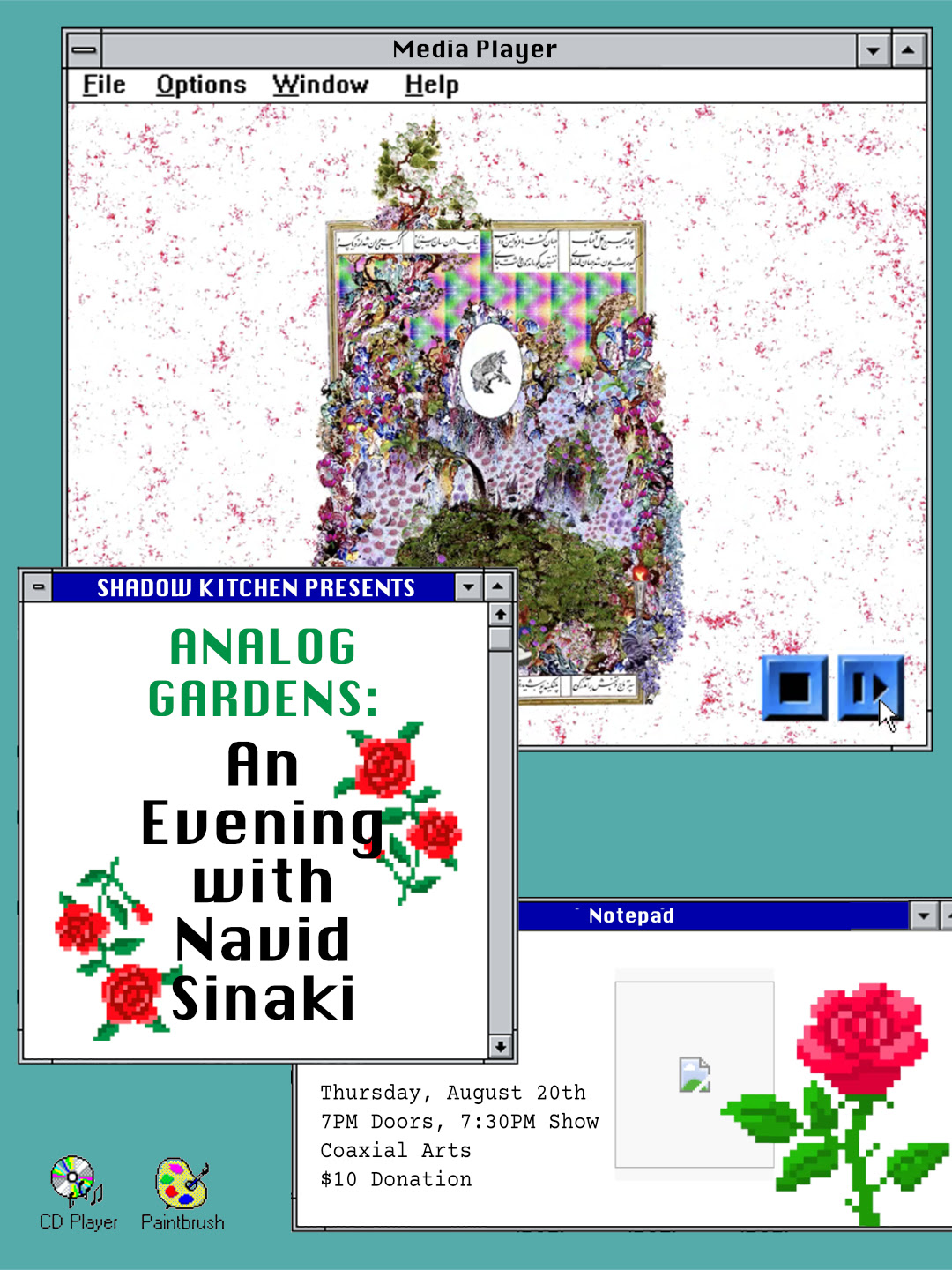
This August, Shadow Kitchen welcomes back alum, artist, and author Navid Sinaki for an evening exploring the overlaps between his writing and art making practices.
Sinaki’s work merges cinema, pop culture, and Persian folklore through digital and analog media ephemera: love letters tucked into DVD menus, turn-of-the-millennium animations, and VHS tapes from films that don’t exist.
His first solo exhibition, THE INFINITE GARDEN, is an invented Persian epic revolving around a king and his three male lovers, rendered across video, digital slide shows, and fabricated archive objects drawn from Shangri La Museum of Islamic Art, Culture & Design. His visual work shares the same preoccupations as his debut novel, MEDUSA OF THE ROSES: queer Iranian identity, myth, and the charged beauty of things hidden or lost.
The evening includes an artist talk on the writing of his novel, along with two short film programs. We begin with one of Sinaki’s own films, RUMI AND HIS ROSES (2022), a project made alongside the writing of the novel in which a gay Iranian recounts his first relationship through bootleg DVD menus. After some conversation, we dive into a second program that turns to Sinaki’s cinematic inspirations and culminates in a single-channel presentation of THE INFINITE GARDEN (2024).
Join us on August 20 at Coaxial Arts for an unforgettable artist talk, in which Sinaki shares his creative inspirations, screens his own films, and reveals a few surprises along the way!
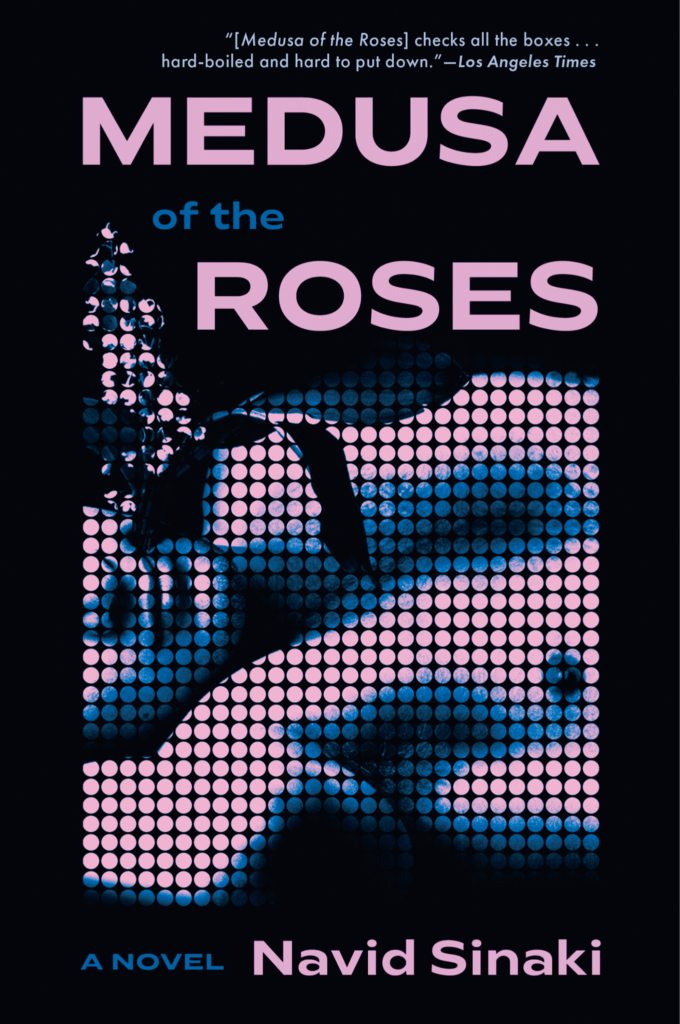
MEDUSA OF THE ROSES
- A CLMP Firecracker Award Finalist
- A Publishers Weekly Writer to Watch
Set in modern-day Tehran, Sinaki’s bold and cinematic novel is a queer literary noir following Anjir, a morbid romantic and petty thief whose boyfriend disappears just as the two are planning to leave their hometown for good. With only a cryptic note to guide him, Anjir searches the city’s streets, clubs, and museum halls in a quest steeped in Persian and Greek myth, one that pushes his morals and gender identity to new places in the pursuit of love and self-determination.
PUBLISHER: Grove Atlantic
“Powerful . . . [Sinaki’s] unflinching and bold debut explores the chilling reality for his gay compatriots in Iran . . . Threaded throughout Medusa of the Roses are references to old Hollywood films – The Postman Always Rings Twice is particularly relevant – as well as allusions to Persian folklore and classical mythology . . . Violence permeates the novel, mirroring the brutal reality of an authoritarian regime . . . the loneliness of having to suppress your desire and identity is powerfully conveyed.”
—Lucy Popescu, The Guardian
FILMS IN THE PROGRAM
POP! (2009)
Persian sexploitation and melodramas from the 1960s are re-animated to tell a love story about a trans woman, her murderous twin, and the man they love in the red-light district of pre-Islamic Iran.
BRUTE (2009)
The Persian epic of “Leyli va Majnun” is reimagined with two women as the lovers. Leyli’s attempted suicide is interrupted by Death, who entices her with a kiss.
RUMI AND HIS ROSES (2021)
Using love letters tucked in bootleg DVD menus, a gay Iranian recounts his first relationship and its end.
THE BLUE PIPER (2022)
Re-imagining Islamic artwork provided by the Metropolitan Museum of Art and the Art Institute of Chicago, queer artist Navid Sinaki animates the story of a king and the curse that turns his lovers into flowers.
THE INFINITE GARDEN (2024)
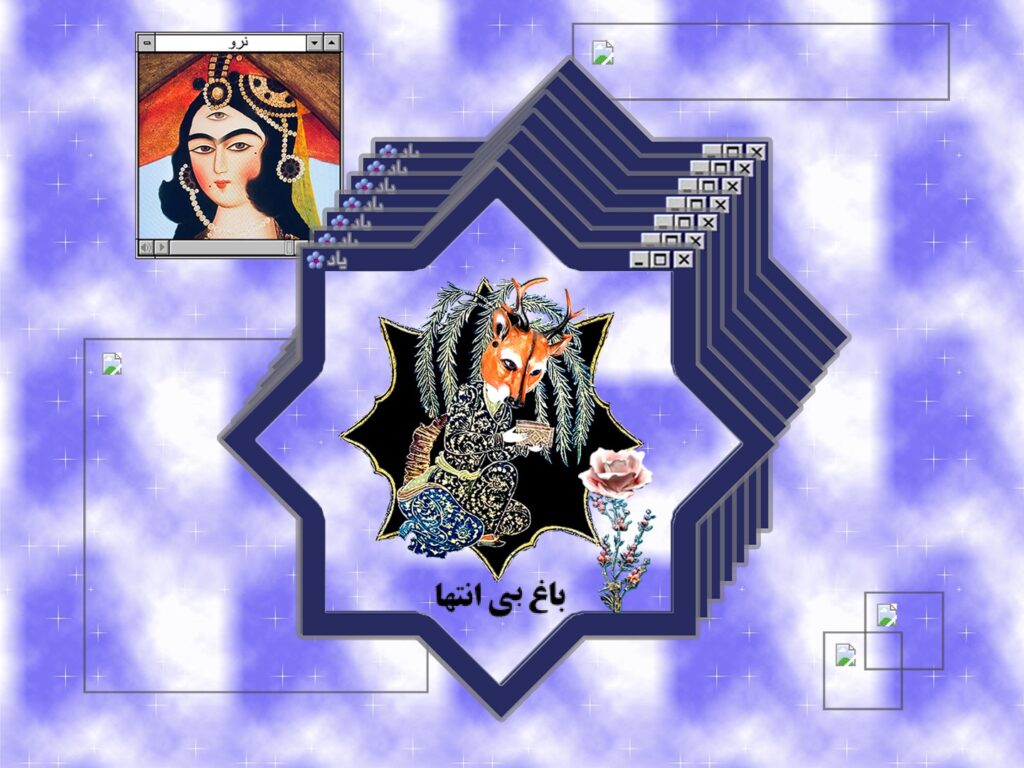
A queer Persian epic that animates ancient Iranian artwork alongside Y2K digital ephemera to tell the tale of a king who builds three gardens, one for each of his storytelling lovers. A riddle decides which lover he will keep, and which two he will kill.
ARTIST BIO
NAVID SINAKI is an artist and writer from Tehran who currently lives in Los Angeles. His works have been exhibited at museums and art houses around the world, including Lincoln Center, the British Film Institute, Cineteca Nacional in Mexico City, and the Modern Museum in Stockholm. His first solo art exhibition The Infinite Garden debuted at Shangri La Museum of Islamic Art, Culture, and Design and the Honolulu Museum of Art.